Blog
November 13, 2026
Your AI Forgets Everything. So We Gave It Better Memory.
Reasonara v2 remembers a billion tokens of your work, hands the AI only what each question needs, and runs without the cloud. Here's how it works, what it scored, and how it's coming to Olyvr.
Introducing Reasonara v2: a billion tokens of memory, small enough for a laptop
Nov 2026 · Syed Ishtiaque Ahmed, Liang Zhao, David Klubeck, Emiliano Berenbaum, Max Murshed, Alan Ngo, Hasibul Haque
 Reasonara v2: a billion-token memory for AI agents
At a glance
-
What it is: Reasonara v2 is a memory for AI agents that holds a billion tokens of your work and hands the AI only the few records each question needs.
-
What it scored: 90.08 on EnterpriseRAG-Bench, ahead of Claude Code searching the raw files, in about two minutes a question.
-
What's next: Olyvr already uses earlier versions of this research. The full v2 design is coming to Olyvr next.
If you use a coding agent, you've watched this happen. Every morning it opens a codebase it has seen a thousand times and reads it again from scratch. It searches. It opens yesterday's files. It burns minutes and hundreds of thousands of tokens re-learning what a teammate would just remember. Then it answers.
Multiply that by every agent, every question, every day.
That isn't a model problem. Today's models are smart enough. It's a memory problem. And a bigger context window doesn't fix it.
Today we're sharing Reasonara v2, our research on fixing it for good.
The big idea: remember everything, read only what matters
Think of a great librarian. They don't read the whole library every time you ask a question. They know where things are, walk to the right shelf, and hand you the three pages that answer it.
Reasonara v2 works the same way. It splits memory into two parts:
-
What it remembers. Everything: your code, tickets, incidents, documents and decisions. This can grow past a billion tokens, roughly the working knowledge of a thousand experienced people.
-
What the AI reads. For each question, just the handful of original records that answer it. This stays small, however big the memory gets.
Stuffing everything into the AI's window costs more, and the AI gets worse as the window fills. It loses track of what's in the middle. Handing it only the right evidence is cheaper, faster and more accurate.
What that looks like
Say you ask: "Why did checkout start failing after Tuesday's deploy?"
An agent without memory greps the repo for "checkout", opens a dozen files, reads the deploy diff, maybe searches the ticket tracker, and pieces together a guess. Ten minutes and a few hundred thousand tokens later, it might have found the cause.
An agent with Reasonara starts from what's already mapped. Tuesday's deploy changed a payment timeout setting. That setting caused a spike in failed calls. Those failures match an incident ticket opened Wednesday, and a decision from three months ago explains why the timeout was set where it was. The agent gets those four records, with links to the originals, and answers in seconds.
Same question. One agent hunts; the other remembers.
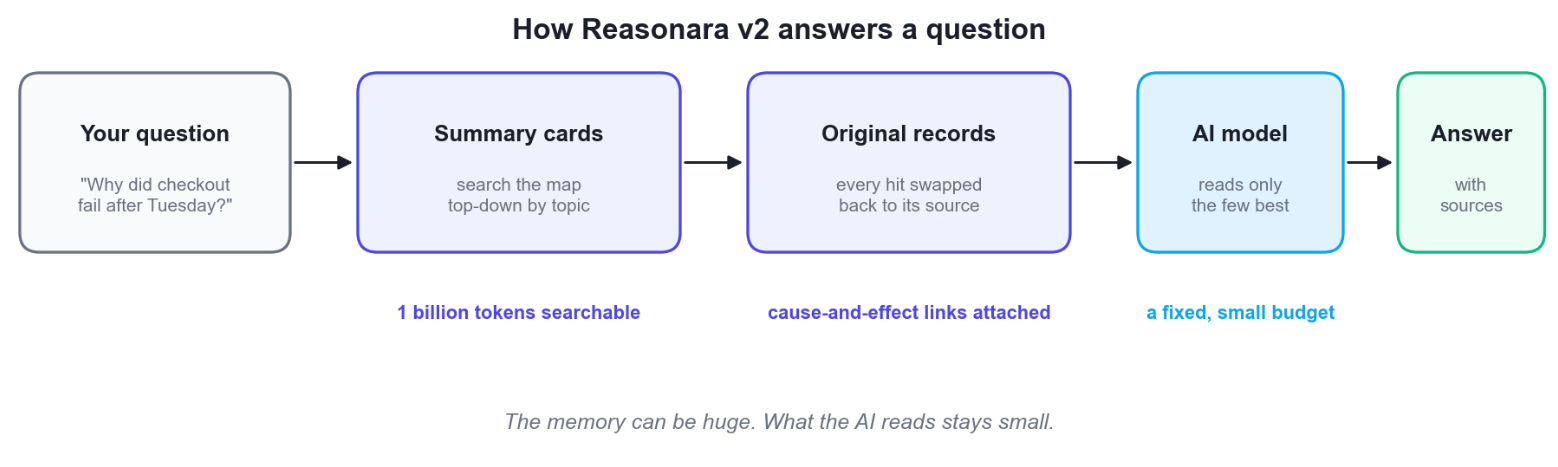 How Reasonara v2 answers a question
How it works
1. It builds a map of cause and effect
Most AI search tools keep a pile of text snippets and look for similar words. Reasonara builds a map. Every point on it is one meaningful thing: a decision, a rule, an event, a fact. The lines between them say how they connect: this caused that, this came after that, this contradicts that.
That's how a business actually works, and it's how the memory answers why, not just what.
2. Every memory has a summary card and the original page
This is the heart of our first paper, MegaMem.
Each memory is stored twice:
-
a short summary card that's quick to search and matches questions even when they use different words from the source, and
-
the original page, with its exact wording and where it came from.
Reasonara searches the summary cards to find things. But it always hands the AI the original page, never the summary. Summaries help it search; the originals are the evidence. Every answer then shows which records backed it up, so you can check it.
3. The memory organizes itself, and keeps what matters close
This comes from our second paper, MemOnDemand.
No two companies file things the same way, so Reasonara doesn't force a fixed filing system. It groups related memories into topics, then topics into bigger themes, and decides for itself how many levels each collection needs. A question starts at the top and drills down, like going from a book's contents page to a chapter to a paragraph.
It also learns from use. Memories that keep helping answer questions are kept close at hand. Ones nobody needs fade into the background. What matters stays loud; what doesn't goes quiet.
4. It doesn't need an AI model to build the memory
Reasonara builds its map without calling any AI model. It doesn't call out to an API or send data anywhere. Our 512,000-document test set, about 850 million tokens, built in 106 seconds.
That's why it can run on a laptop, and why your data can stay there.
5. Four speeds, one memory
You choose how hard it works on each question:
-
Odyssey writes several answers, checks each one against the evidence and picks the best. It's the most thorough.
-
Compass writes several answers and picks the best.
-
Spark plans, finds the evidence and answers in one pass.
-
Blink gives a quick lookup and a quick answer, in seconds.
Routine questions go fast. Hard ones get the full treatment. They all share the same memory.
The results
We tested Reasonara v2 on three public benchmarks, each scored by its official judge.
Benchmark | What it tests | Reasonara v2 | For comparison |
EnterpriseRAG-Bench | 500 questions over 512,000 company documents | 90.08 | Claude Code searching the files: 88.31 |
LoCoMo | Remembering long conversations | 91.62 | Whole history given to the AI: 82.5 |
LongMemEval | Long-term chat memory | 91.4 | Reasonara v1 (May): 87.4 |
The enterprise result is the one we're proudest of. The obvious alternative to a memory is to let a top AI agent search the raw files itself. It works if you give it time. With 15 minutes per question, Claude Code scored 88.31. With 5 minutes, 81.72. With 1 minute, 35.64.
Reasonara scored 90.08 with a median of about two minutes per question, because the hard searching was already done when the memory was built. Its time goes into reasoning, not hunting.
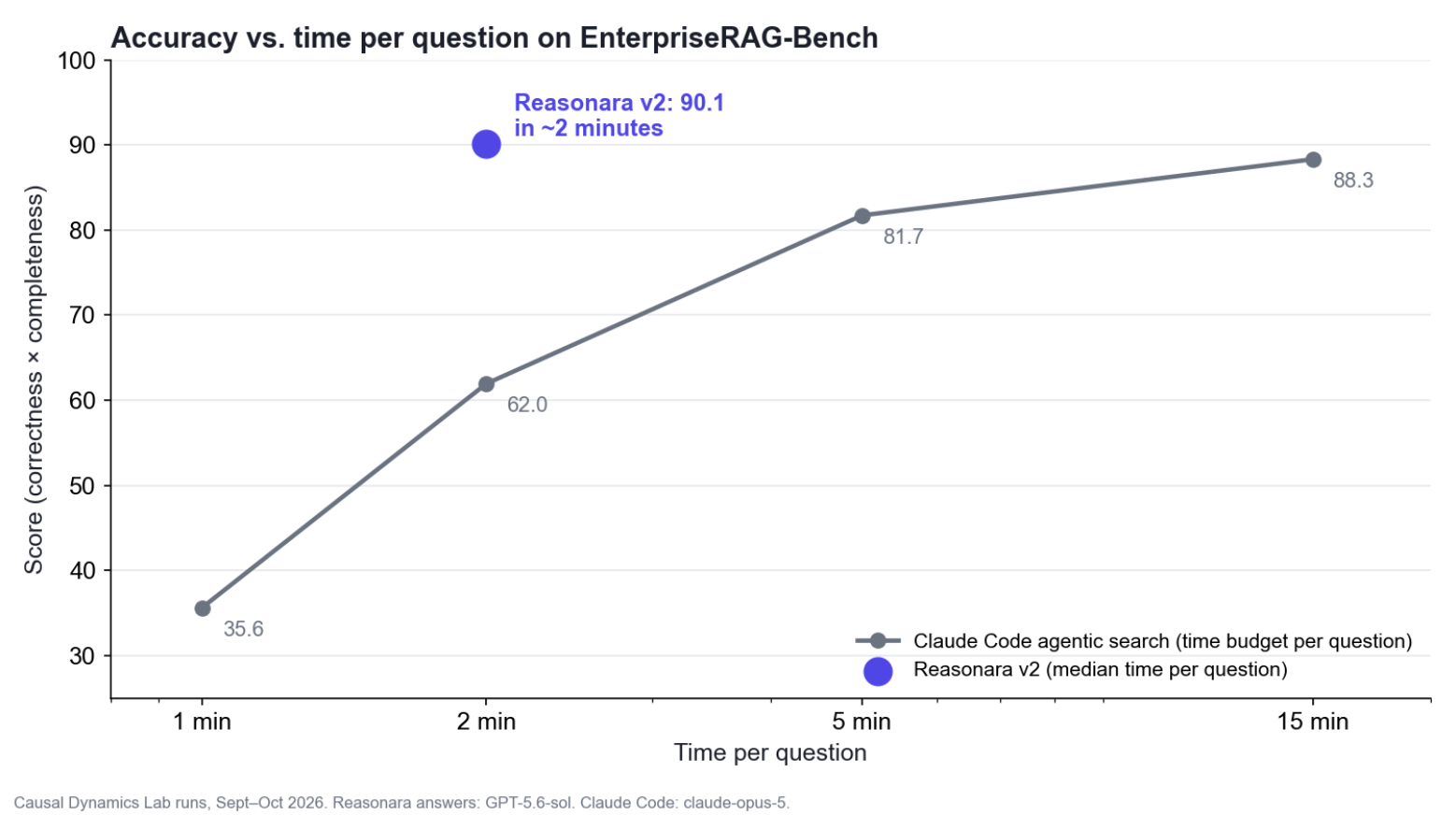 Accuracy vs. time per question on EnterpriseRAG-Bench
It's affordable, too. The single-pass Spark tier ran the entire LongMemEval benchmark, 500 questions, for $11.70.
Why this matters
A smaller AI is enough. Once the memory does the knowing, the AI only has to reason over a few records. That's a job for a small model, not a giant one. The value is in the memory, not the size of the model.
It can run on your own machine. Laptops can now run capable AI models locally. What they've lacked is the memory of your work. Reasonara is that missing half.
Your data can stay private. No one wants to send their code, contracts and customer records to a hosted model on every question, and many teams aren't allowed to. With the memory and the model on one machine, nothing has to leave.
Answers you can check. Every answer points back to the original records it came from.
For engineering leaders
Most of what your agents spend goes on searching, not thinking. Studies of coding agents put 60 to 80 percent of their tokens on finding their way around a codebase, and that bill grows with every repo, every engineer and every agent you add.
A memory does that search once, when your data comes in, instead of on every question. That means:
-
Lower spend: agents read a few records instead of re-reading the codebase.
-
Faster answers: seconds to minutes, not ten-minute search sessions.
-
Less risk: the memory can live on your own machines or in your own cloud, and every answer shows its sources.
-
Faster onboarding: a new engineer's agent starts with the team's history instead of from zero.
Available today in Olyvr
Olyvr is our memory and context layer for AI agents, and it already puts earlier versions of this research to work.
-
Company memory, built in. Connect your organization's Reasonara memory to Olyvr. Every question searches it alongside your own sources, at the speed tier you choose.
-
Olyvr TeamMind. Host a shared memory for your team on your own server, so every teammate's agent draws on the same history.
-
Memory that tidies itself. Olyvr Mind already uses an early form of MemOnDemand. Documents your answers keep citing rise in importance, stale ones fade, and related work is grouped into short, cited digests while you're away.
-
A local model, out of the box. Olyvr runs a local open model, Qwen3.6 35B-A3B, so your questions and your memory can stay on your laptop.
Coming next: Reasonara v2 inside Olyvr
We're now bringing the full v2 design into Olyvr. Here's what that adds:
-
Olyvr Mind becomes a billion-token cause-and-effect memory of your own work: your repos, tickets, incidents and decisions, built on your laptop. Any agent you use reads from it, so a new session or a new agent never starts from zero.
-
Olyvr TeamMind becomes your team's shared map. What one person's agent learns that matters to everyone is promoted there. A new engineer's agent arrives already knowing the team's history.
-
Olyvr CollectiveMind links teams together. When your team's memory can't answer something, it can reach the team that owns the service, handled last year's incident, or changed the API. Each team keeps owning its own memory.
-
Every answer cites its sources, and the evidence is resolved to the original record.
-
Smaller, local models do more, because the memory hands them exactly the right evidence.
A billion tokens is the size of one memory, not the limit. Linked together, the memory your agents can reach is many teams times a billion.
Read the research, try Olyvr
-
MegaMem: A Retrieval Solution for Ultra-Large Context Windows. Read the paper on arXiv · Code on GitHub
-
MemOnDemand: A Memory Management System for Large-Scale Enterprise Data. Read the paper on arXiv · Code on GitHub
-
Try it: Download Olyvr, or get in touch about Olyvr and Reasonara for your team.
The models already work. Your knowledge is already there. What was missing was the memory in between. Now it fits on the machine in front of you, and it remembers the way your business actually works: by cause and effect.
All benchmark runs were made by Causal Dynamics Lab in September and October 2026 and scored with each benchmark's official judge. Reasonara answers used GPT-5.6-sol; the agentic baselines used claude-opus-5. Each Reasonara score is its best tier on that benchmark. Claude Code latency is shown at its time budget; Reasonara at its median. Full figures are available on request.